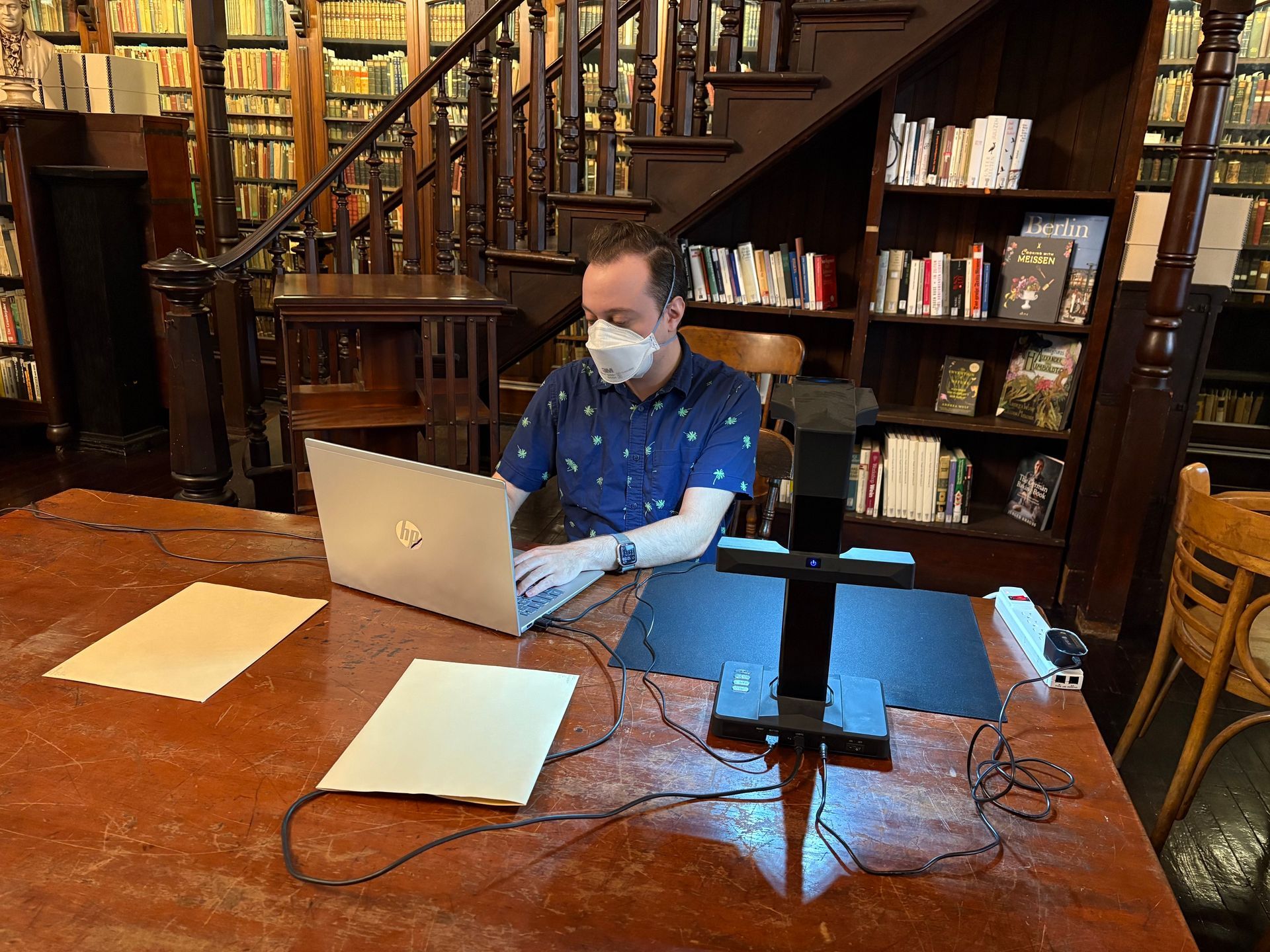
This summer I had the privilege of working with the German Society’s Agentur collection – more specifically, the agent’s letterbooks from 1880 and 1911. The Agentur, or “agent”, was employed by the German Society to meet the needs of recently arrived, poor German immigrants. This portion of the collection consists of letters the Agentur mailed out to organizations and individuals in an attempt to resolve difficulties faced by aid-seeking German immigrants. Although tantalizingly vague (as we only retain one side of the conversations), these letters give us a brief but intimate view into the lives and struggles of recently arrived immigrants at the turn of the century.
Some matters come up again and again in these letters, denoting that they were frequent experiences. For example, the Agentur often writes to immigrants’ employers who are unlawfully withholding wages. The Agentur also writes to railroad and shipping companies asking for low-cost charity fares – which the German Society then pays – for poor Germans who cannot afford a ticket to their destination.
In many cases of requests for charity fares, Germans are self-deporting after facing immense difficulty in the United States.
On pages 289-291 of Box 38, Agent Joseph Bernt writes to the Bureau of Immigration of the Port of Philadelphia to draw their attention to the case of a woman who, just 6 months prior, followed her husband to the United States with their three children only to be deserted by him. Bernt writes that the woman used the little money she had on the “most necessary purchases” upon arriving in a new country, and is now completely destitute and unable to support herself and her children. In a time without a welfare net or autonomy for women, Bernt says that she will “surely become a public burden” and thus must return to her family in Silesia (what is today Poland with parts in Germany and the Czech Republic). Bernt explains that the German Society will pay for the woman’s passage should the Bureau be able to get her there. The central individual of this matter, the woman, goes unnamed throughout the lengthy letter, leaving us with only this small glimpse of her life.
In the seven letterbooks with which I have worked, each numbering close to 1,000 pages, there are also many letters alluding to stories that are more unusual. By the time I was digitizing Box 38 of the collection, I began noting down letters that caught my attention.
Letters did not have to be long to have fascinating contents. On page 389 of Box 38, Bernt writes to the warden of “the Eastern [State] Penitentiary” to follow up on a prisoner who would like a German-Spanish grammar book (which the Society is happy to provide). Like most letters in this collection, this one leaves us with unanswered questions about the context surrounding this request.
In a letter not specifically about immigrant aid but no less confounding, on pages 575-576 Bernt writes to the Lieutenant of the Philadelphia police. Bernt asks the police to investigate, as every Sunday, a “hord” [sic] of boys besets the German Society building. Bernt was spurred to involve the police when one boy threw a large stone through the Society’s window, shattering an expensive pane of glass. Questions again abound: was this indicative of wider anti-immigrant prejudice? While working in the German Society building and enjoying the large and ornamental windows, I can only imagine the cost of replacing one.
In what is undoubtedly the most dramatic story I came across while digitizing these volumes, on pages 398-399, Bernt writes to a lawyer requesting his assistance. Bernt explains that, after learning about the German Society from a newspaper, Anna Naegele came to them seeking help for her incarcerated brother, Rudolph Kister. Rudolph had previously been married, but his former wife passed away, leaving him with four young children. Nevertheless, he married again, only to find that this was also the second marriage of his new wife (whose name is never mentioned). That would not have been a problem except that this woman had never been legally divorced from her first husband, meaning that she now had two husbands.
Anna reports that, when Rudolph discovered this, the second wife absconded, leaving Rudolph to care for their young, shared child. The second wife sued Rudolph for alimony and obtained a judgment against him for a payment of $2.50 per week. Rudolph did not have the money and was sentenced to 90 days in Moyamensing Prison, leaving his five young children alone and “in great distress”.
Bernt asks the lawyer to which the letter is addressed, a Mr. Ernest Stefan, Esqr., to investigate the case. Sadly, Bernt concludes the letter by saying, “I told Mrs. Naegele that I will submit this case to our solicitor, but do not expect, that something can be done”.
During another brush with the law, Bernt writes to the General-Consulate of the United States of America in Berlin to have them investigate and potentially arrest a thief travelling from Philadelphia. The alleged thief is Julius Meger, who found a German immigrant by the name of Oscar Meger living in Philadelphia and claimed to be his relative. Oscar let Julius stay in his home, only for Julius to flee back to Germany with $300 worth of Oscar’s property – a value of over $11,000 today. Bernt gives the Consulate a description of Julius: he claims to have fought for the German Army in China and Southwest Africa, as the middle finger of his right hand is wounded by a gunshot, and he has further wounds on his neck. He is “rather tall”, around 27-30 years old, and said his family is from near Berlin. Bernt concludes the letter asking that they “call the attention of the Police Department of Berlin to this rascal”.
Finally, on page 272, Bernt responds to an inquiry about usage of the Society’s library: the same library in which I am currently working that now houses this letter collection. Bernt informs the inquirer, Mr. Conrad B. Alater, that the library is a public one which can be accessed during library hours for an annual membership fee or per diem entrance fee.
If you, like Mr. Alater, are inspired to visit the German Society’s library, it is open on Tuesdays and Thursdays from 10:00 am to 4:00 pm. You can schedule a visit by emailing
librarian@germansociety.org. Additionally, you can now digitally access the Agentur collection (among other fascinating materials) by visiting the online
PA Power Library.